

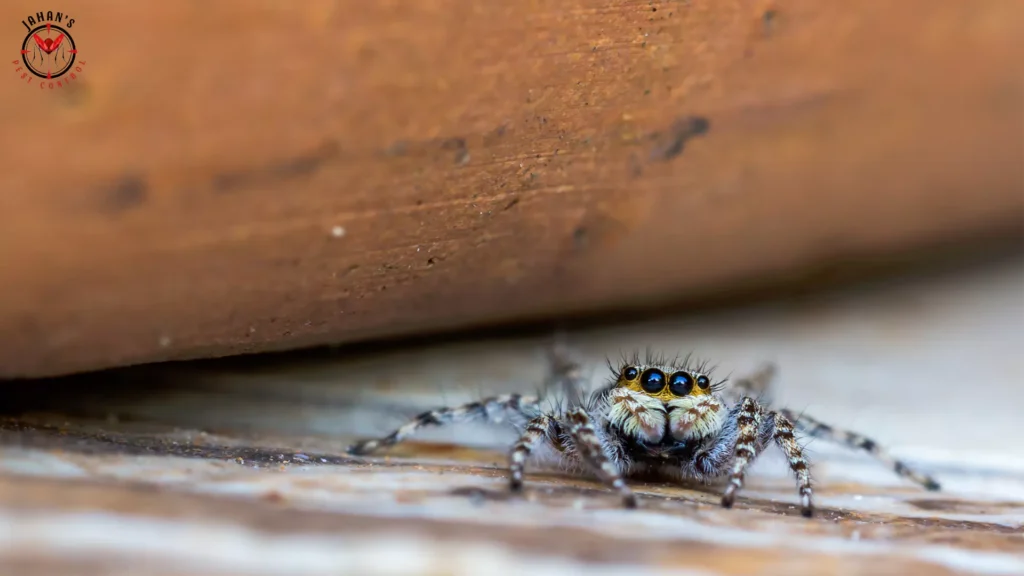
Most Sydney homes will have arachnids nearby at some point. That does not mean the house is unclean or infested. A visitor turns up after finding an accessible gap, enough insect prey, or a protected place to rest. Start outside, work inwards, and deal with those three conditions in that order.
Australian Museum guidance puts the risk in perspective: many arachnids prey on insects and few Australian species are harmful to people. The aim is not to strip every animal from a garden. It is to keep them out of living areas, sheds used each day and family spaces where an unexpected encounter creates concern.
Quick answer: To prevent spiders from entering your Sydney home, close physical access first. Repair screens, door seals and service gaps. Next, reduce insect activity around lights, bins and food areas. Finish by clearing sheltered hiding places near the house. A licensed pest manager is the right next step for repeated indoor activity, redbacks near people or pets, or any spider you cannot identify safely.
Start with the entry points that matter most
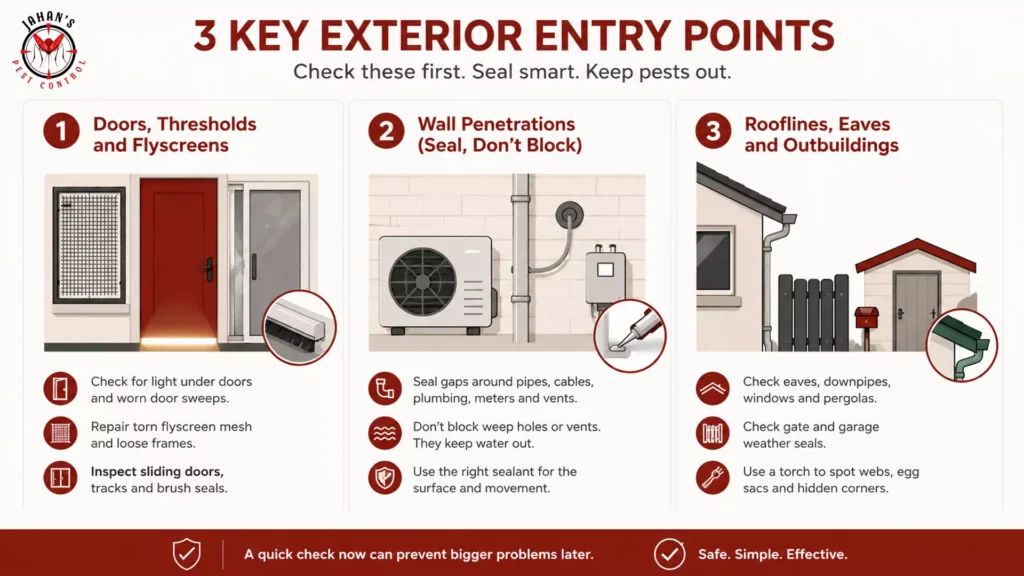
The exterior check works best as a short walk around the outside of the home. Carry a torch, a notepad and a phone for photos. Inspect each spot below before buying a spray or filling every hole with sealant.
1. Check doors, thresholds and flyscreens
Stand outside each external door at night with the indoor light on. Light showing beneath a closed door points to a gap that needs attention. Replace worn door sweeps, adjust a loose strike plate, and repair torn flyscreen mesh. Check sliding doors too, particularly the lower track and the brush seal at the closing edge.
A screen only works if it closes fully. Look for lifted corners, loose frames and gaps around pet doors. Garages deserve the same check. A roller door with a damaged bottom seal can leave a broad ground-level route into the garage, then into the house.
2. Inspect wall penetrations without blocking drainage
Look around air-conditioning pipework, hot-water lines, NBN or other cable entries, plumbing, meter boxes and exhaust outlets. Small gaps around these penetrations can be sealed with a product suited to the surface and movement of the material.
Do not plug brick weep holes or vents with foam, mortar or a makeshift patch. Australia’s government-backed Your Home guide defines a weep hole as an opening designed to drain accumulated water from a concrete or brick wall. If a cover is needed, ask a builder or qualified pest manager about a purpose-made cover that keeps the drainage path open.
3. Look at rooflines, eaves and outbuildings
From ground level, scan eaves, downpipes, window frames, pergolas, letterboxes and outdoor storage. A torch often reveals old webs, egg sacs or sheltered corners that are hard to see in daylight. Check weather seals on side gates and garage access doors.
Do not climb onto a roof or reach into a dark cavity to inspect it. A professional can check high or enclosed areas where access is unsafe.
Cut off insect prey near the house
Arachnids hunt insects. Australian Museum guidance describes this group as important predators of insect pests, so a steady concentration of moths, flies, ants or cockroaches near an entry point can give a visitor a reason to stay nearby.
This part of spider prevention is often missed. A house can be tidy inside and still have a busy insect feeding zone outside a doorway.
Review outdoor lighting after dark
Switch on each exterior light for a few evenings and watch what gathers around it. If moths and other flying insects cluster near a door or window, turn off lights that are not needed, use a timer or sensor, and aim fittings down towards the walking surface rather than across the garden or wall.
Night lighting can alter nocturnal insect activity and predation, yet the effect varies with the species, brightness, direction and colour of the light. Treat the change as a simple home test: change one fitting, then watch the insect activity around the same entrance for a week.
Keep food waste and other insect sources contained
Rinse recyclable containers, close outdoor bins, wipe barbecue spills, and avoid leaving pet food outside overnight. This route is indirect: food residue can increase insect activity, giving a hunter more prey around the home.
If cockroaches are active around the kitchen, laundry, garage or bin area, deal with that issue rather than treating the visible arachnid alone. Insect activity may be part of the pattern.
Remove sheltered spots without stripping the garden
Dense vegetation, stacked materials and outdoor furniture can create protected places close to a wall. The goal is a visible, inspectable strip around the house, not a bare yard.
Create a clear inspection zone
Trim branches and climbing plants so they do not rest against the building. Move pot plants, timber, spare tiles and stored items away from external walls. Store firewood and garden gear on a rack or shelf, rather than directly on the ground. Use lidded plastic tubs for rarely used items instead of loose cardboard boxes.
There is no single clearance distance that fits every Sydney block. The useful test is simple: can you see the wall, check the ground line and clean the area without moving a thicket of plants or stored materials? If not, the space needs attention.
Check the places people touch
Inspect the underside of outdoor chairs, play equipment, pot rims, pool equipment, garden sheds, wheelie-bin handles and clotheslines. Use gloves for gardening and check shoes or gloves left outdoors before putting them on. Healthdirect gives the same practical advice for reducing the risk of a spider bite.
Do not handle a suspected redback, funnel-web, mouse spider or an unidentified large dark spider. Keep children and pets away from the area, then arrange safe removal or identification.
Keep indoor hiding places easy to inspect
Indoor prevention is less about constant cleaning and more about reducing surprises. Vacuum corners, skirting edges, curtain tracks, wardrobes and the space behind furniture during normal house cleaning. Empty the vacuum outside after a session if you have removed webs or egg sacs.
Before carrying boxes, shoes, prams or sporting gear in from a garage, balcony or shed, check the undersides and folds. Take extra care with laundry baskets, footwear and towels that have been left outside. A single wandering spider does not prove an infestation, yet repeat sightings in the same room deserve a closer look at nearby gaps, clutter and insect activity.
Match the response to what you find
| What you notice | First response | Get professional help when |
| One ordinary web on an accessible eave | Remove the web, inspect the nearby frame and watch for new web-building. | The web returns quickly or several nearby sites become active. |
| Flying insects collecting at one doorway | Adjust lighting, repair the screen and check bins or outdoor food spills. | Cockroaches, flies or ants are active across more than one area. |
| A redback or egg sacs near play equipment, pet areas or outdoor seating | Isolate the area. Do not disturb the spider or reach under the item. | A trained technician can inspect the harbourage and assess the immediate risk. |
| A large dark spider that cannot be identified | Keep clear and take a photo from a safe distance if possible. | It is in a high-use area, you suspect a funnel-web or someone may have been bitten. |
Avoid fixes that create new problems
Some popular DIY spider-control methods can create building, ventilation or chemical-safety problems instead of solving the original entry point. Before sealing, spraying or using a repellent, make sure the fix addresses the source without creating a new hazard.
- Do not seal drainage openings, permanently block vents, or cover building defects with expanding foam. Fix the relevant gap without changing the building’s drainage or ventilation function.
- Do not use a pesticide in a location or against a pest that is not listed on its label. The Australian Pesticides and Veterinary Medicines Authority states that a label covers the product’s approved uses and directions.
- Do not treat a scented oil, vinegar mix or ultrasonic device as the main defence. It does not repair a screen, close a service gap or remove insect prey. Use physical exclusion and housekeeping as the foundation of spider prevention.
- Do not assume every arachnid is dangerous. Most are not, yet any potentially dangerous or unidentified animal near people, pets or hands-on tasks needs distance and care.
When professional spider control is the sensible next step
Arrange an inspection if webs keep rebuilding after entry points and harbourage have been addressed, if redbacks or egg sacs appear in high-use spaces, or if indoor sightings continue without a clear source. A technician can check active sites, assess the insect prey issue and decide whether targeted treatment is appropriate for the property.
For a Sydney home that needs that level of assessment, Jahan’s Pest Control provides spider control in Sydney. The scope of any treatment should follow what is found at the home, not a generic spray plan.
What to do after a suspected spider bite
This is a safety point, not a home-treatment task. If a funnel-web or another big black spider may have bitten someone, call Triple Zero (000) for an ambulance. Keep the person still and use pressure immobilisation for a bite on a limb. For a redback bite, Healthdirect advises washing the area with soap and water, using a cold pack for 15 minutes, and seeking medical care for severe symptoms. Read the full Healthdirect first-aid advice.
FAQs About Keeping Spiders Out of Home in Sydney
Can I prevent spiders from entering my Sydney home permanently?
No. Spiders can move in from nearby gardens, bushland and neighbouring properties. Good spider prevention lowers the chance of indoor encounters, yet no treatment or repair can guarantee a permanently spider-free property.
Do spiders inside a home mean the house is dirty?
No. A clean home can still have a torn screen, a loose door seal, insect prey near a light, or a gap around pipework. Start with access and prey before blaming household cleanliness.
Does removing a web solve the problem?
Removing a web improves visibility, but it does not remove the spider’s access route or prey source. Check the nearby frame, eave, light and vegetation before deciding the job is complete.
Are natural spider repellents enough on their own?
No. A scent spray may change the smell of a small area, yet it does not fix a door gap or prevent insects from gathering near a light. Put money and effort into physical repairs first.
How often should I inspect for spider entry points?
Run the outside check twice a year and after new plumbing, cabling, exterior repairs, screen damage or a storm that affects seals. Homes near dense vegetation may need a more frequent look. There is no one timetable that suits every property.
Are white-tail bites a medical emergency?
White-tails are not considered dangerous to humans, and current evidence does not link their bites to skin ulcers. Seek medical advice if pain is severe, does not settle, or swelling or itching worsens.